
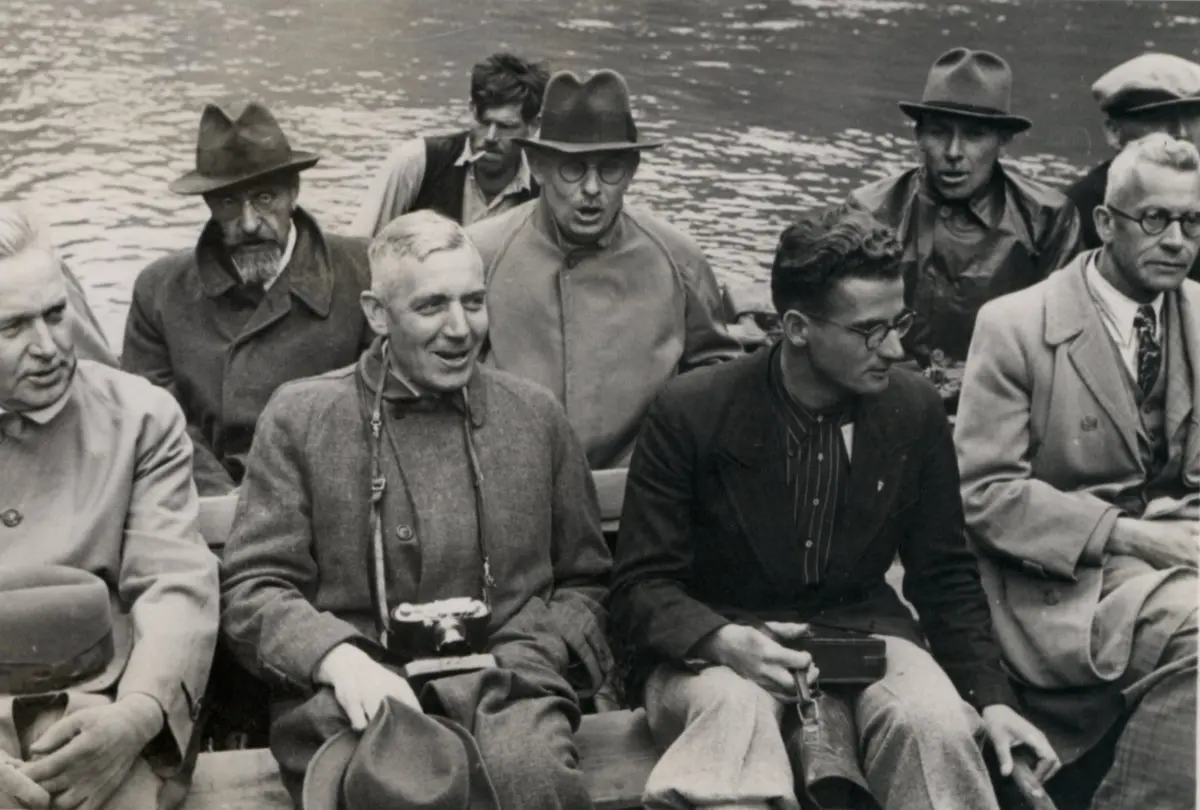
At the end of the 19th century, German (and German-speaking) Folklore Studies (Volkskunde) initially developed primarily outside of universities, particularly in associations (Vereine) and museums. In the German Reich it was only gradually established as an institutional discipline from the 1930s onwards. This development is closely linked to the history of National Socialism, in which the concept of the “ people” (Volk) and, in particular, the Volksgemeinschaft took on central political and ideological significance.
Hand in hand with this political climate, the concept of the people (Volk) also became a leading category in various academic disciplines. Volkskunde claimed particular expertise in this area, which not only contributed to its academic establishment but also gave it specific political relevance. An important role in this context was played by the study of German minorities abroad – the so-called Auslandsdeutsche or Volksdeutsche. These groups were often examined in the context of Sprachinselvolkskunde, especially with regard to the “ German” minorities in Eastern and Southeastern Europe. As historiography has repeatedly shown, Sprachinselvolkskunde was politically highly charged and at the same time associated with the claim to give Volkskunde a sharper methodological profile.
Volkskunde was often associated with geographical mobility. Research trips, extended stays in other countries, and work in regions labeled as “ foreign” were part of scientific practice. This required crossing national borders on the one hand and contact with actors beyond these borders on the other. These included, for example, actors in the field of Volkskunde within the states in which the German minorities lived. Such contacts often gave rise to personal and institutional networks that were shaped by political, institutional, and economic conditions. Nazi foreign policy and the expansion of the Nazi state into Eastern and Southeastern Europe had a lasting impact on border demarcations, mobility, contacts, and networks.
The workshop takes as its starting point the history of German and German-speaking Volkskunde and its engagement with “ German” minorities outside national borders. It focuses on the prerequisites, subjects, and consequences of cross-border interactions: To what extent did national borders, states and different political frameworks structure folklore studies practice? Which actors were involved? Under what political and institutional conditions did exchange, cooperation, or demarcation take place? And what scientific, political, and social effects did these interactions have? How the emergence of far-right political movements and regimes during 1930s and early 1940s influenced folklore research and international collaborations in Europe, and what role played the German and German-speaking Volkskunde in this process?
At the same time, German Volkskunde, with its interest in minorities beyond national borders, was not a special case. Folklorists in other countries also dealt with comparable issues— albeit under different scientific, political, and social conditions than in German-speaking countries, especially during the Nazi era. And with different consequences. The workshop therefore explicitly focuses on the history of these national folklore disciplines: on the one hand, in their interconnection with German Volkskunde of the respective period, and on the other hand, in comparison with it. Thus, the workshop aims also to enlarge the focus and welcomes approaches entailing a comparative view or drawing on a entangled history of various European cases, which might help us better understand the German Volkskunde and its echoes abroad. Furthermore, the 1920s and 1930s should not be viewed in isolation, but questions regarding preconditions, consequences, and continuities (and thus also periodization) should also be addressed.
Workshop Program
Friday, September 18
Writing Transnational Histories of Folklore Studies
- 9:15 – 9:45 Welcome Speech
- 9:45 – 10:30 Frauke Ahrens Re-Contextualizing Karl Weinhold’s “Was soll die Volkskunde leisten?” (1890): Prospects for a Transnational History of Early Folklore Studies
- 10:30 – 11:00 Coffee Break
Trans-/International Entanglements and Collaborations in the Field of Folklore Research from Interwar to Postwar Period
- 11:00 – 11:45 Corneliu Pintilescu Transnational Academic Networks in the Field of Folklore Research and Far-Right Radicalization in East Central Europe: The Case of Transylvanian Saxon Folklorists (1922-1944)
- 11:45 – 12:30 Iria Ameixeiras From Jesús Bal y Gay to Marius Schneider: Folklore Transformations from the Second Spanish Republic to Francoism
- 12:30 – 14:00 Lunch Break
14:00 – 14:45 Matthias Thaden Many Hands: Gustav-Adolf Küppers, Local Intermediaries and the Making of the Southeastern Europe Collection at the Museum Europäischer Kulturen (Berlin)
Folklore Research in the German-speaking Space and Its International Echoes: Institutions, Networks and Practices
- 14:45 – 15:30 Zuzana Panczová Research on German Ethnic Groups in Slovakia During World War II: Institutions and Individuals
- 15:30 – 16:15 Anne Friederike Delouis French Perspectives on German Volkskunde Research in the 1930s: between Distancing and Rapprochement
On Site
- 16:45 – 17:45 Guided Tour (Tilman Kasten) Archival Holdings of the Institute for Cultural Analysis of the Germans of Eastern Europa
19:00 Conference Dinner
Saturday, September 19
Experts in Entangled Orders of Knowledge
- 9:15 – 10:00 Tobias Weger Two Ethnographic Perspectives on Dobruja: Eugène Pittard and Paul Träger
- 10:00 – 10:45 Viktoria Muka The “Volkstumsforscher” Franz Hieronymus Riedl (1906–1994), his Networks, and the Emergence of German “Volkskunde” in Hungary
- 10:45 – 11:15 Coffee Break
- 11:15 – 12:00 Wilhelm Julian Gruber "Viennese Professors and Their Guests": The 1937 Transylvania Excursion and the Making of völkisch Scholarly Networks
- 12:00 – 12:45 Tilman Kasten Becoming an Expert: Johannes Künzig Explores Areas of Research (1920s and 1930s)
- 12:45 – 13:30 Final discussion
The workshop is open to the public. To participate, please register by September 10, 2026, at the following email address: Tilman.Kasten@ikde.bwl.de